|
|
 |
 |
 |
|
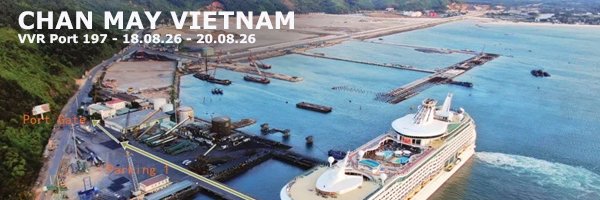
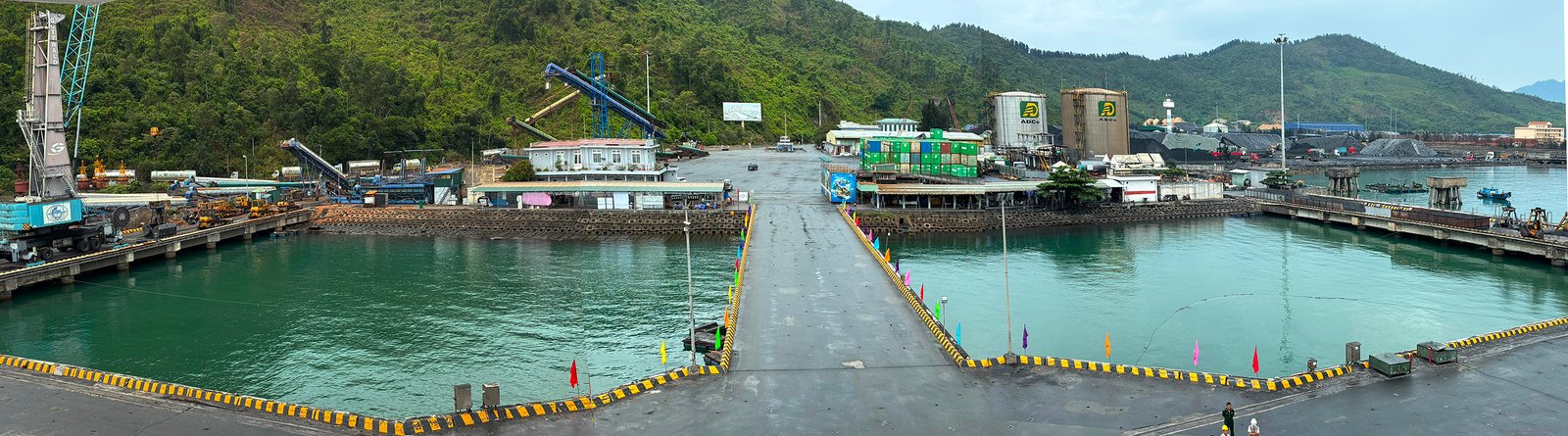
Where the Mountains Enter the Sea August 18–20, 2026 Marti Eicholz We arrived at Chan May in that hushed hour when the body has not yet decided if it belongs to sleep or to the day. I remember standing at the rail with my hands still cool from the cabin, watching the morning gather itself over the bay in pale layers of pearl, salt, and heat. The ship rested against the working pier like some immense white animal pausing for breath, and beyond the cranes and containers, beyond the blunt geometry of labor, the land rose with astonishing tenderness: green mountains folding inward, mist caught in their shoulders, the sea turning from gray to turquoise where the first light touched it. I felt, before I had words for it, that something in me had gone quiet enough to listen. Chan May did not rush toward me. It did not offer the easy seduction of boulevards, shopfronts, or neon declarations. It waited, almost shyly, as thresholds do. A deep-water gate cut into the central coast of Vietnam, it holds cargo ships and cruise liners beneath the same open sky; it lets commerce pass through while beauty stands just behind it, patient as a mountain. From here, roads lead north toward Hue and its imperial walls, south toward Da Nang and Hoi An, upward through the cloud-wrapped bends of the Hai Van Pass, and outward toward the long maritime routes of Southeast Asia. But that morning, with the warm air moving against my face, I was not thinking of routes. I was thinking of hinges: how a single place can open something in the world, and also in oneself. The landscape around Chan May seemed to hold opposites the way memory does: without needing to explain them. It was industrial and Edenic, remote and connected, quiet and cosmopolitan. Cargo moved through it; travelers passed through it; fishermen, somewhere beyond the port roads, bent over nets in the soft repetition of work that has outlived every empire. The port belonged to logistics, yes, to schedules and trade corridors and departures, but it also belonged to mist, lagoon, mangrove, and the morning voices of villages I would only glimpse. It stood near Lang Co, near Lap an Lagoon, near the sweep of Bach Ma’s emerald slopes, where water and forest appear to have made an old vow never to be separate. Perhaps that is why the place entered me first through color, as childhood places often do, before language can tidy them into meaning: the lacquered green of mountains after rain, the blue-white flash of light on water, the pewter backs of clouds resting on the pass, the rust-red memory of Hue’s gates waiting inland. Even before we began to move, the day felt full of roads, but also full of return, though I had never been here before. The port itself was only a beginning, a breath before the telling, and I carried into it the private weather of my own life: the fatigue of movement, the ache of wanting to be astonished, the small hope that travel might still make me porous. On the road toward Lang Co, the world softened, and I softened with it. Fishing boats drifted on the lagoon like dark commas, small marks of human patience on a wide reflective page. The water did not glitter so much as remember the sky. Along the shore, daily life moved in a choreography too modest to perform for anyone: nets lifted and lowered, scooters passing with impossible grace, doors open to the humid morning, the scent of salt mingling with woodsmoke and something floral I could not name. I found myself watching with the ache one feels before ordinary beauty, the kind that asks nothing, forgives nothing, simply continues. I thought of how travel often begins with a hunger for monuments, for the named and photographed thing: the citadel, the tomb, the pass, the beach. But sometimes the memory that remains is smaller, more porous, almost domestic. A basin of water outside a doorway. A woman balancing baskets. The brief lift of a hand from a fisherman whose boat rocked in the shallows. The way the mountains seemed not to end at the shore but to continue beneath the surface, dark and secret, holding up the sea. I wondered what my own life looked like from this distance, what parts of it were monuments, and what parts were only water bowls, gestures, fog, the small things that endure because no one has tried to make them grand. The Hai Van Pass rose ahead of us like a long green thought, and the road began to climb as if remembering its own body. It bent and doubled back, pulling us away from the shining lowlands into a corridor of jungle, vapor, and sudden openings of sky. Ocean Cloud Pass: the name felt less like geography than prophecy. Clouds moved across the road in slow white processions. The sea opened and vanished, opened and vanished again, each glimpse more startling for being brief. Below, the coast curved in a blue arc; above, the mountain breathed mist. I pressed my forehead near the glass and felt a childlike wonder return to me, not loud, not innocent, but grateful. At the summit, the air changed. It was cooler, thinner, threaded with the mineral scent of old stone and wet leaves. Fortifications stood in weathered silence, remnants of watchfulness and border, their surfaces softened by moss and time. I stood there between kingdoms of element: mountain behind me, ocean below me, cloud around me, road unwinding in both directions like a question I had been carrying for years without admitting it. There are places that make a person feel small; this one made me feel permeable. The view did not merely impress itself upon me. It entered through the skin. Later, Hue waited with another kind of silence, one I felt in the chest before I understood it. If the coast had spoken in water and wind, Hue spoke in stone, threshold, ceremony, and loss. The Imperial City rose from its moat and walls like an old dream the country still had. Gates stood red and solemn beneath the heat. Courtyards opened beneath the wide sky. Dragons curled along roofs and pillars, not fierce so much as enduring. In the Purple Forbidden City, ruins and restorations shared the same breath; moss grew where footsteps once obeyed imperial order, and trees cast living shade over the absences of palaces. I walked there aware of my own briefness, my own small life moving through the afterimage of vanished rooms. I found myself listening, though no one was speaking. History does not always announce itself as grandeur. Sometimes it arrives as texture: a cracked tile, a worn stone step, a red door faded by monsoon and sun. It arrives as the quiet ache of realizing how many lives have passed through a place before one’s own astonishment, and how little of them can be held. The royal city did not feel dead to me. It felt inhabited by weather, by memory, by the careful patience of restoration, and by strangers moving slowly through heat, their umbrellas opening like small moons. I wanted to touch everything and disturb nothing. Somewhere in Hue, the scent of lemongrass and chili rose from a bowl of bún bò Huế, rich and red and fragrant, and I understood again that a place enters the body more honestly than it enters the mind. It comes through heat, spice, broth, hunger, the sting of chili on the lips, the steam rising into the face like a blessing one does not have to deserve. The soup held its own kind of history: royal refinement made local, local appetite made immortal. It tasted of depth and brightness, of patience and fire. After the citadel’s vast courtyards, it was a more intimate architecture, built in steam and bone and herb, and for a few minutes I was not a traveler looking outward; I was simply a body being warmed. By evening, returning toward Chan May, the day had gathered itself into gold. The lagoons near Lang Co caught the lowering sun and held it tremulously, as if light itself had become water. Villages slipped past in fragments: a blue gate, a roadside altar, laundry lifted by the breeze, children’s voices somewhere beyond the road. I felt the tenderness that comes at the end of a day one cannot keep. The people who lived there were not figures in a one’s landscape but the keepers of its daily continuance, fishing, trading, cooking, waiting, repairing, welcoming, beginning again. Their lives gave the coast its pulse, and mine, passing through, could only listen for it. When we left early on the morning of August 20, the sea was still dark at its edges. The ship moved away from the port, and Chan May receded into a blur of mountain, pier, and pale sky. |
|
Copyright © 2026 All rights reserved |