|
|
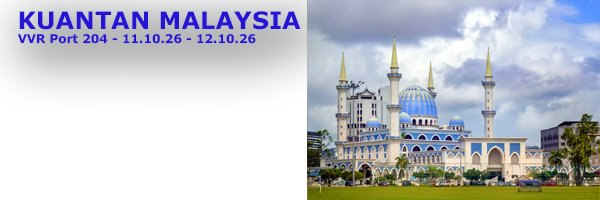
Kuantan:Where the Sea Keeps Its Own CounselOctober 11–12, 2026 Marti Eicholz After four days at sea, land returned to us slowly, not as a dramatic revelation, but as a deepening of color along the horizon. The South China Sea, which had carried the Odyssey away from Laem Chabang and through long, unbroken days of water, softened beneath the morning light. Then came the low green line of Malaysia, the long arms of the breakwater, the cranes and vessels of Tanjong Gelang. Kuantan did not greet us with a polished passenger terminal or a theatrical sweep of palms. It received us as a working coast receives the world: with steel, salt, industry, heat, and the grave patience of ships. There was something honest in that first sight. Mountains of cargo rose beyond the quay; warehouses and container yards stretched beneath a sky already bright with tropical intention. Nearby, behind guarded roads and high-security gates, the Royal Malaysian Navy kept watch over the eastern seaboard. Beyond all of it lay the open sea, the same sea that had brought merchants, fishermen, miners, soldiers, and now us to this headland. The port seemed to hold every version of Kuantan at once: the quiet river settlement it had been, the trading town it became, and the modern gateway it had determined to be. As we traveled toward the city, the severity of the port loosened. Roads opened into neighborhoods and roadside stalls; flashes of bougainvillea leaned over walls; motorbikes moved lightly through the traffic. Kuantan revealed itself without hurry. It had none of the restless insistence of a capital eager to announce its importance. Instead, it seemed to breathe with the rhythm of the east coast; river, monsoon, fishing boat, prayer. Even in the heat, there was a spaciousness to it, a sense that the city had not forgotten the slower life from which it grew. At the heart of Kuantan, the Sultan Ahmad 1 State Mosque lifted its blue-and-white domes into the brightness. The minarets seemed less to pierce the sky than to converse with it. Their geometry was precise, yet the effect was tender: cloud-colored domes, pale walls, shadowed arches, the whole structure appearing to float above the day’s commotion. I stood for a while before it, aware of how sacred buildings alter the air around them. Traffic continued. People came and went. Yet beneath the city’s ordinary movement was a stillness, and within that stillness, an invitation to listen. The Kuantan River carried another kind of silence. Along its banks, mangroves gathered themselves in dark green abundance, their roots descending into the tidal water like patient fingers. The river widened toward the sea, holding reflections of sky, boats, and buildings in a surface that was never entirely still. Across the mouth lay Tanjung Lumpur, a fishing village where the day’s catch would meet charcoal and flame by evening. There, smoke curled into the warm air, sambal flashed red against grilled fish, and the scent of the sea returned transformed, salt made savory, labor made generous, a meal made communal. I tasted Kuantan in small, memorable ways: the chew and spice of keropok lekor, the dark sweetness of local coffee, fish laid over coals until its edges charred and its flesh yielded beneath the fork. Food here did not feel separate from place. It carried the coast within it, the fishing villages, the morning markets, the monsoon weather, the hands that cleaned, ground, wrapped, stirred, and waited. At my age, I have learned that memory often keeps what the itinerary forgets. Long after the names of roads have faded, the fragrance of smoke and chili can reopen an entire afternoon. Inland, the story of Kuantan deepened into stone. Sungai Lembing had once been called the El Dorado of the East, a place where tin drew people downward into a vast subterranean world. Beneath the green hills lay hundreds of kilometers of tunnels, shafts descending farther than the eye or imagination could follow. Above ground, a prosperous mining town had bloomed: schools, a hospital, electricity, a cinema, a country club. Then the price of tin collapsed, the pumps fell silent, and water began reclaiming the darkness. Prosperity departed with astonishing speed, leaving the town to grow quiet around the memory of what had sustained it. That history moved me more than I expected. Perhaps it was the thought of lives built around something believed to be permanent; the mine, the company, the town’s bright future, and how quickly permanence revealed itself as a story people had told one another. I know something now about the fragility of plans, about homes that change shape and futures that refuse to remain where we placed them. Yet Sungai Lembing had not vanished. Morning still arrived over the hills. Coffee was poured. Doors opened. The river continued through the valley. What endured was not the old certainty, but life’s quieter instinct to begin again. Before dawn, Bukit Panorama belongs to darkness and effort. The climb rises in a long discipline of concrete steps beneath the rainforest canopy. Above, the sky gradually releases its blackness; below, the town becomes a scatter of softened lights. At the summit, mist fills the valley until the surrounding hills appear as islands in a white inland sea. Then the sun reaches the horizon, touching the clouds first with pearl, then rose, then gold. To stand above that luminous silence is to feel, briefly, that the world has been remade without noise. We returned to the Odyssey through the working landscape of Tanjong Gelang. The cranes were still turning; trucks moved through the yards; ships waited beyond the breakwater. Yet the port no longer seemed merely industrial. I could see behind it the river and mosque, the fishing fires, the buried mine, the green hills rising above their sea of clouds. Kuantan had become layered within me, a place of labor and prayer, appetite and memory, ambition and impermanence. As evening gathered, the coast receded into haze. I watched from my floating home while Malaysia slipped back toward the horizon. Some places astonish at once; others enter quietly and continue unfolding after departure. Kuantan asked to be noticed, to look beyond the cranes toward the sea, beyond the abandoned tunnels toward the lives once lived inside them, beyond the landscape toward the human courage that keeps making home wherever the light returns. |
|
Copyright © 2026 All rights reserved |